
Hip dysplasia in dogs: helping them stay mobile
A swaying walk, bunny hopping, struggling to get up? How to recognise the signs of canine hip dysplasia, what to ask your vet and how to adapt your dog's daily routine.

Hip dysplasia in a nutshell
The hip is a ball-and-socket joint: the head of the thigh bone should fit snugly into a socket in the pelvis. In a dog with hip dysplasia (canine hip dysplasia), it doesn't fit properly. The joint is loose, wears faster and arthritis can develop over time.
- Partly inherited, and more common in large breeds such as German Shepherds, Labradors and Golden Retrievers.
- Aggravating factors: growing too fast, being overweight, too much strenuous exercise as a puppy.
- Diagnosed by a vet: through a gait examination and X-rays. Only your vet can confirm hip dysplasia and assess how advanced it is.
Hip dysplasia symptoms to look out for
- A swaying walk: the hips roll from side to side as your dog walks.
- "Bunny hopping": running with both back legs moving together.
- Struggling to get up after a nap or first thing in the morning.
- Avoiding the stairs, or jumping into the car or onto the sofa.
- Tiring quickly and stopping or lying down on walks.
- Thinner thighs: losing muscle at the back end.
- Sitting with the back legs to one side rather than square.
These signs can have other causes. Note when they appear and talk to your vet.
Your vet decides on the care plan
See your vet promptly if your dog suddenly starts limping, seems to be in pain or won't put weight on a leg. Depending on your dog's age and how advanced the dysplasia is, your vet will suggest a suitable care plan, such as weight control and gentle, regular exercise.
A back leg brace is not part of that care plan. It is a comfort accessory, to be used alongside it and with your vet's agreement.
Living with a dog with hip dysplasia
- A healthy weight: every kilo lost takes pressure off the hips. Your vet can set a target.
- Little and often: several calm walks on the lead are better than one long outing or intense ball games.
- Floors with grip: non-slip rugs on tiles and wooden floors, where your dog gets up.
- Fewer jumps and steps: a ramp for the car, and a stair gate if needed.
- A firm, thick bed, away from cold and draughts.
Where a back leg brace can help
A brace does not correct the hip and does not replace any treatment. It provides support for both back legs while walking, for dogs that still walk on their own but whose back end tires.
- Both back legs at once, linked by a reinforced triangular connector: weight is spread more evenly than with a brace on a single leg.
- Adjustable: straps and hook-and-loop fastenings, elastic belly band.
- Breathable neoprene, with a non-slip design so it stays in place.
Check before you order: sizes XS to XXL, based on thigh measurement (up to 40 cm) and chest measurement (up to 88 cm). It is not suitable for dogs with short legs and long bodies (dachshunds, corgis), or for very large dogs outside the size guide. If your dog mainly needs to be carried, a harness with a handle is a better choice.
Frequently asked questions
Can hip dysplasia be cured?
The right care depends on your dog's age and how advanced the dysplasia is, and your vet decides on it. Our brace is not a treatment; it is a comfort accessory for walking.
At what age do the signs appear?
Sometimes while a young dog is still growing, sometimes only in adulthood or later in life, as arthritis develops. If in doubt, ask your vet for an examination.
Can my German Shepherd or Labrador wear it?
Yes, if their measurements are within the guide: up to 40 cm around the thigh and 88 cm around the chest (size XXL). Measure before you order; if in doubt, email us your measurements.
How long can my dog wear it?
Start with short periods on walks, then adjust with your vet's advice. Take it off if you notice any discomfort, redness or irritation.
Is it a medical device?
No. It is a comfort and support accessory. It does not replace a veterinary diagnosis or treatment.
What are the delivery times and returns terms?
Orders are processed within 1 to 3 working days, then UK delivery takes 5 to 14 working days (6 to 17 working days in total). UK delivery is a flat £3.45, shown at checkout before you pay. You can cancel within 14 days of delivery under UK consumer law, and our returns policy lets you request a return within 30 days of receipt.
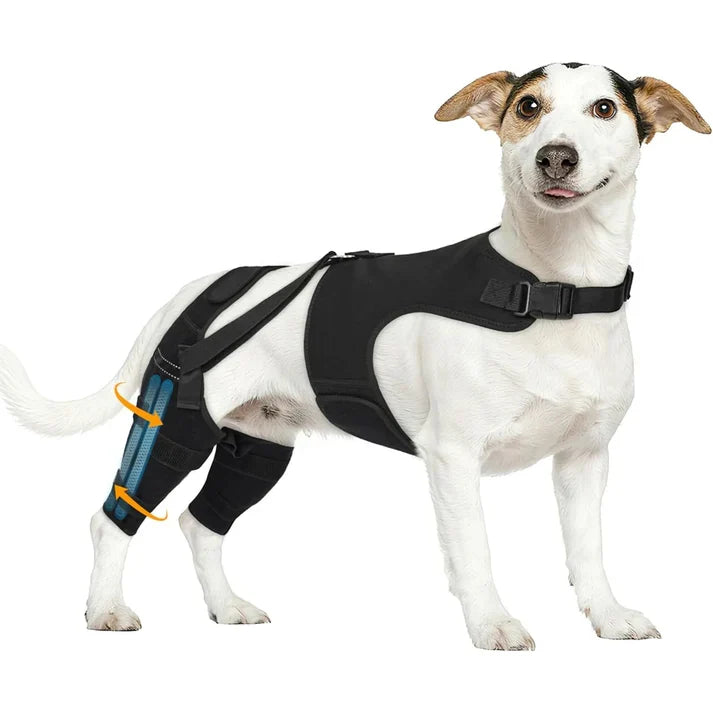
Support for both back legs
Breathable neoprene, adjustable straps, non-slip design. Sizes XS to XXL.
£89.95
See the back leg braceUK delivery £3.45 · 30 days to request a return
A comfort and support accessory, not a medical device. Ask your vet for advice.