
Dog's back legs weak or giving way?
Weak, wobbly or collapsing back legs, stiffness or a limp on a back leg? Here's how to recognize the signs, when to see your vet and how to help your dog day to day.

Signs your dog's back legs are getting weak
- Limping on a back leg, when getting up or after a long walk.
- Back legs giving way: the back end sways, gives out or collapses.
- Hesitating in front of the stairs, the car or the sofa.
- Back legs shaking or wobbly when standing still.
- Losing muscle at the back: the thighs look less muscular than before.
- Slipping on tiles or wooden floors.
Why a dog's back legs get weak
Several causes can combine. Only your vet can say which apply to your dog.
- Age. Many older dogs lose muscle in their back legs, especially the thighs. Less muscle means less stability.
- Joints. Stiffer hips or knees can make walking feel less comfortable, especially in older dogs.
- Favoring one leg. When a dog spares one leg, the other works harder and tires more quickly.
- Excess weight. Every extra pound puts more strain on the back end.
When to see your vet
Book an appointment promptly if:
- your dog suddenly starts limping, seems to be in pain or won't put weight on a leg;
- its back legs can no longer carry it, it drags them or seems paralyzed: this is an emergency;
- the signs appear suddenly or get worse;
- you're not sure whether a brace is right for your dog: ask your vet before using one.
A brace is a support aid, not a treatment. It does not replace a diagnosis or veterinary care.
Helping your dog day to day
- Non-slip floors: a few rugs on tiles or wooden floors, where your dog walks most.
- Shorter, more frequent walks, at your dog's own pace.
- Keeping an eye on weight with your vet, to keep the joints comfortable.
- Fewer jumps: a ramp for the car or sofa, and a stair gate if needed.
- Suitable support for getting around, if your vet has no objection.
Support harness or back leg brace?
- A support harness with a handle lets you take some of your dog's weight. It's handy for occasional help (stairs, the car), but you have to walk bent over beside your dog.
- A leg brace supports a single leg.
- A back leg brace supports both back legs at the same time. They are linked by a reinforced triangular connector, and body weight is spread more evenly while your dog walks on its own.
If your dog mainly needs to be carried, a harness with a handle is still the best choice. If your dog still walks but its back end tires, the brace supports it step by step.
Which dogs is it for?
It may suit older dogs whose back legs are getting weak or stiff, less steady dogs who need a little extra support day to day, and active dogs whose back end works hard. If you're unsure, ask your vet.
It is not suitable for dogs with short legs and a long or broad body (for example corgis or dachshunds), or for very large dogs whose measurements are outside the size guide.
Sizes XS to XXL: measure around the thigh and chest, then compare with the guide on the product page.
Frequently asked questions
My dog's back legs are weak or it limps, but it doesn't seem to be in pain: what should I do?
Weakness or a limp, even without obvious pain, should be checked by a vet. Note when it happens (when getting up, after exercise): this will help your vet.
Why are my old dog's back legs getting weak? Could it be arthritis?
With age and less activity, the thigh muscles often waste away, and arthritis can make the back legs stiff. Only your vet can confirm the cause and recommend suitable care and exercise. A brace does not treat arthritis: it is a comfort and support accessory.
How long can my dog wear the brace?
Start with short periods so your dog gets used to it, then adjust the wearing time with your vet's advice. Take the brace off if you notice any discomfort, redness or irritation.
Should I ask my vet before using it?
If you're unsure whether the brace suits your dog, ask your vet for advice first. Then start with short periods so your dog can get used to it.
Is it a medical device?
No. It is a comfort and support accessory. It does not replace a veterinary diagnosis or treatment.
What are the delivery times and returns terms?
Orders are processed within 1 to 3 business days, then US delivery takes 5 to 14 business days (6 to 17 business days in total). US shipping is a flat $7.95, shown at checkout before you pay. Our returns policy lets you request a return within 30 days of receipt; return postage is at your expense.
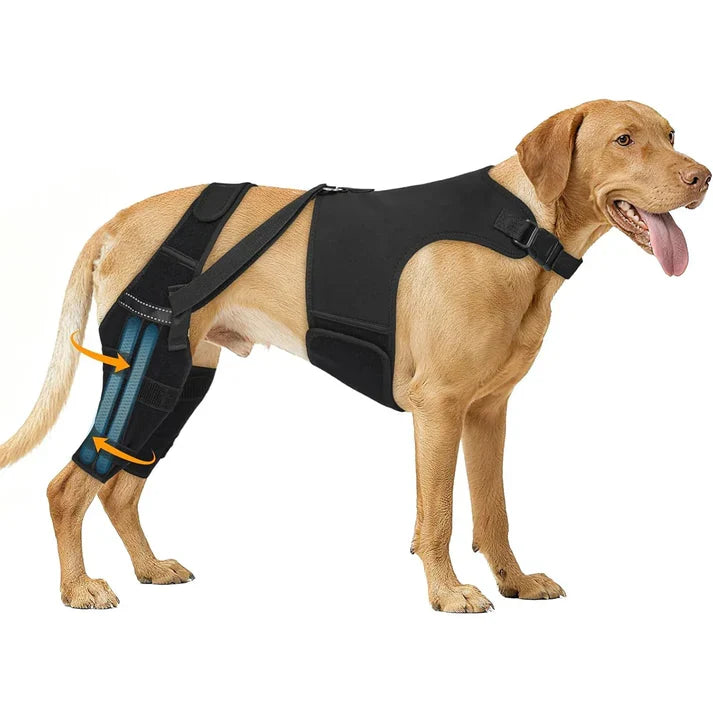
Support for both back legs
Breathable neoprene, adjustable straps, non-slip design. Sizes XS to XXL.
$99.95
See the back leg braceUS shipping $7.95 · 30 days to request a return
A comfort and support accessory, not a medical device.